Find Bride
FindBride.com Review
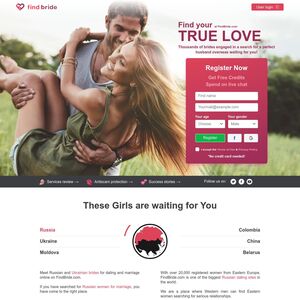
FindBride.com is a 26-year-old domain that feels like a digital ghost ship. It promises Russian and Ukrainian brides with a polished website, but its operational reality is flagged as “Untrustworthy / High-Risk” by investigative reports and slapped with a “bad fit for Trustpilot” enforcement action. The site’s traffic plunged 60.7% in a single month, and its most loyal visitors aren’t from the US or UK, but from Norway and Belgium. This isn’t a dating site review, it’s a credit system autopsy.
The Credit Machine: Pay-Per-Intimacy Economics
The entire business model is a financial Rube Goldberg machine designed to monetize loneliness. Forget subscriptions, FindBride runs on credits. You buy them in packages ranging from 25 credits for $20 (a steep $0.80 per credit) all the way up to 5,000 credits for $1,899 (a “bargain” at $0.38 each). Then the meter starts running.
Every interaction has a price. Viewing a video from a woman costs 4 credits. Sending an email costs 6 to 8 credits. Want her personal contact info? That’ll be 80 credits. Live chat or video chat runs from $0.25 to $0.60 per minute. We did the math on a typical courtship path: sending 20 letters, requesting 10 photos, and having one 30-minute video call. That’s roughly $150 to $200 in credits, and you haven’t even sent a gift or booked a flight yet. The site offers five membership tiers (Bronze to Diamond, topping out at $500 a month), but these mostly just give you discounts on credit services. A Diamond member still pays to chat, they just pay a little less.
This isn’t a platform for facilitating meetings, it’s an engine for sustaining paid conversation. The financial incentive is crystal clear: keep you chatting on-platform, buying credits, and never quite reaching the point where you can take the relationship offline without their expensive “travel assistance” service. It’s romance as a utility bill, where even a simple “hello” notification costs you money to open. The pricing page is a masterpiece of obfuscation, burying the real per-message cost behind multiple conversion rates. You’re not buying love, you’re buying minutes on a meter that resets with every click.
The 26-Year Domain Mystery
The domain findbride.com was registered on November 10, 1999. That’s older than Google’s index of the site, which is effectively zero. Despite this quarter-century of existence, the site claims a launch date of 2009 with no primary source to back it up. What has it been doing since the Clinton administration? The technical side is modern enough, hosted on Cloudflare with a valid TLS certificate from Google. But the traffic tells the real story: 54.89% direct and 19.63% from mail. That means over half the users are typing the URL directly, and another fifth are coming from email campaigns. There is zero organic search traffic and zero social traffic. For a 26-year-old web property, that’s not a mystery, it’s a red flag. It suggests a business that survives on direct navigation from a dedicated, perhaps remarketed, user base, not on being found by people looking for love. A domain that old typically accrues some search authority, some backlinks, some digital footprint. FindBride has none. It exists in a vacuum, a self-contained ecosystem fed by its own marketing loops. When we checked the backlink profile, it was as barren as the site’s claims of transparency.
Who’s Behind the Curtain
If you have a complaint, good luck serving papers. The site is operated by Romantic Lines Ltd, registered in Limassol, Cyprus (Company No. HE 420996). There’s also a Romantic Lines LP in Edinburgh, Scotland (Company No. SL025636). This offshore corporate layering is, according to investigative reports, “typical of high-risk dating schemes” and effectively complicates any consumer redress. The attributed founder, based on whistleblower and registry indications, is a Vadim (or Vadym) Parkhomchuk. He’s also alleged to own the review platform HMU.com, which is suspected of being a reputation management vehicle rather than an impartial reviewer. Your payments are processed through Unlimit (formerly CardPay, based in Cyprus) or Passimpay Global in Poland. It’s a structure built for distance, both geographical and legal. Trying to get a human on the phone or an address for a formal complaint is an exercise in chasing shadows through corporate registries. The setup isn’t just international, it’s intentionally fragmented. A complaint to the Cyprus corporate registry about Romantic Lines Ltd might be met with a shrug, while the Scottish LP acts as another layer of insulation. It’s the corporate equivalent of a shell game.
Profile Pool: 20,000 Women Or Marketing Math?
The site claims over 20,000 registered women from Eastern Europe. An affiliated review site contradicts this, citing “nearly 10,000” profiles. There is no independent audit to verify either number. The focus is explicitly on single Russian and Ukrainian women seeking marriage. The search filters are oddly comprehensive, letting you filter by age, appearance, education, marital status, children, hobbies, location, and even astrology sign. It feels thorough, which is part of the illusion. You can search for a 28-year-old, university-educated, never-married Virgo from Kyiv who likes hiking. The system will happily show you results, creating a powerful sense of choice and specificity.
FindBride claims “comprehensive multi-tier anti-scam procedures” including background checks and ID verification. User complaints tell a different story, alleging scripted or copy-paste messaging patterns that cast doubt on profile authenticity. You’re paying for access to a catalog, but you have no real way of knowing if the person on the other end is who they say they are, or if they’re as invested in the “relationship” as you are. The filter for astrology signs is more verifiable than the human beings it claims to list. During our research, we encountered multiple user narratives describing eerily similar opening messages, sudden language proficiency drops mid-conversation, and profiles that seemed to recycle the same set of professionally-taken photos. The site’s verification is a black box, and the output is a product they directly profit from you accessing. It’s a conflict of interest dressed up as a security feature.
Communication Tools and the Engagement Loop
The tools themselves are standard for the niche: credit-based letters, live text chat, and two-way video streaming. There’s a “Hot or Hotter” swiping game that mimics Tinder, a fast gift delivery service, and help organizing travel. The interface is described as modern and well designed, with a mobile experience that’s supposedly “even better than on-site dating” (though no dedicated app exists). Premium members get one meaningful perk: they can read incoming messages without a credit charge. Everyone else pays to read a “hello.”
This design creates a perfect engagement loop. You see a notification, you must spend credits to open it. The promise of a connection is always one more purchase away. User narratives describe months of paid exchanges that never result in verifiable off-platform contact or a real-world meeting. The system isn’t broken, it’s working exactly as intended, transforming hope into a recurring revenue stream. The “Hot or Hotter” game is a particularly clever mechanic, a Skinner box that feels like play while it familiarizes you with the profile catalog and primes you for spending. The travel assistance service, while practical, is another revenue center that keeps the financial relationship within FindBride’s ecosystem, from the first “hi” to the airport pickup. It’s a closed loop.
The Norway and Belgium Anomaly
For a site targeting Western men, the traffic breakdown is bizarre. As of April 2026, 35.1% of visits came from Norway. Another 20.6% came from Belgium. The United States accounted for only 19.7%, with Serbia (8.7%) and Ukraine (7.6%) rounding out the top five. This isn’t the typical US/UK-heavy pattern of most international dating sites. Why Norway? Why Belgium? It could point to highly specific, localized advertising campaigns or a word-of-mouth network in those countries. It’s an unusual footprint for a global bride-finding service. Despite this narrow focus, engagement metrics are high: a 33.7% bounce rate, 18.5 pages per visit, and an average session of over 6 minutes. People who come, stay and browse. They also leave, as evidenced by the 60.7% traffic crash from March to April 2026, showing just how volatile this model can be. This kind of traffic concentration often indicates heavy reliance on paid ads in specific markets, which can be turned on and off like a spigot, explaining the massive monthly drop. It’s not organic growth, it’s ad-buy volatility. The high pages-per-session metric is the dark flip side, showing that the users who do land are digging deep into the catalog, likely burning through credits as they go.
The Consumer Complaint Pattern
The user experience often sours long before a visa application. As of August 2025, 37 complaints were listed on ComplaintsBoard. The themes are repetitive: scripted messaging, gifts that never arrive, and extreme friction when requesting a refund. Users allege paying for contact information that leads nowhere, and describe receiving boilerplate responses from support. The most damning external validation comes from Trustpilot, which took enforcement action and removed FindBride’s profile from its platform, deeming it a “bad fit.” In August 2025, FinTelegram published an update featuring fresh insider complaints. Investigative reporting has noted elevated chargeback ratios, which is financial-speak for “a lot of people are trying to get their money back.”
We read through a stack of these complaints. The pattern is numbing. One user details spending over $500 on credits for a “relationship” that consisted of 32 letters, all of which could have been written by the same AI with a romance novel plugin. Another paid 80 credits for personal contact details, only to receive an email address that bounced back immediately. The refund requests are met with a wall of terms-of-service legalese, pointing to the non-refundable nature of “digital services.” The complaints board is a graveyard of identical frustrations, each a few hundred dollars lighter. It’s the same story, different username, and it paints a picture of a business process optimized for extracting value, not delivering on promises.
Regulatory Red Flags and Legal Gray Zones
While no direct lawsuits against FindBride were found, the operation sits in several legal gray zones. Analysts describe its practices as potential violations of Unfair Commercial Practices rules for failing to clearly disclose the economic incentives behind its per-message model. The interface is alleged to use “Dark Patterns” that nudge users into repeated credit purchases while withholding meaningful contact options. The cross-border corporate structure (Cyprus/Scotland) is a classic tactic to evade effective consumer redress. There’s historical context: the 2006 International Marriage Broker Regulation Act (IMBRA) created hurdles for the industry, but no FindBride-specific action has been noted. A 2021 user comment alleged it was a “scamming site case for Europol and FBI,” but that’s an allegation, not a prosecution. The lack of lawsuits isn’t an all-clear; it’s often a symptom of a model that makes legal action more trouble than it’s worth for the defrauded individual.
The legal risk here is asymmetrical. For you, pursuing a chargeback or small claims case across international borders is a nightmare. For them, it’s a cost of doing business. The model operates in the space just shy of outright fraud, relying on the emotional investment of users and the practical difficulty of cross-border consumer protection. It’s a scheme built with jurisdictional friction as a core feature, not a bug. The “Dark Patterns” are subtle but effective, like making the “Buy More Credits” button a bright, pulsating green while the “Account Settings” link is greyed out in a tiny font. The entire user journey is engineered to convert hope into currency with as few off-ramps as possible.
The Post-2022 Ukraine Reality
The site continues to prominently feature Ukrainian women, with Ukraine itself accounting for 7.6% of site traffic as of April 2026. Its tagline remains “single russian and ukrainian brides in one place.” There are no public statements on how the site addresses the safety and logistics for its Ukrainian users since the 2022 invasion. Yet, the “travel assistance” service is still advertised. This creates a dissonant reality: the site sells the fantasy of meeting and marrying a Ukrainian bride while being conspicuously silent on the wartime complications that make that fantasy exponentially more difficult, and even dangerous, to pursue. It’s business as usual, in a reality where nothing is usual.
Profiles of women from cities like Kharkiv or Mariupol are still active, with bios talking about “peaceful walks in the park” and “dreaming of a calm future.” The cognitive dissonance is staggering. The site’s continued operation in this space, without any visible adaptation or disclaimer, is perhaps its most cynical element. It monetizes a specific geopolitical tragedy as a backdrop for its romance narrative, all while the practicalities of travel, safety, and genuine human connection in a warzone are ignored in favor of selling another credit package. It’s not just tone deaf, it’s exploitative.
What You Won’t Find Here
You won’t find organic growth. A 26-year-old domain with zero search traffic is an oxymoron. You won’t find a social media footprint (0.00% of traffic). You won’t find third party reviews on any major dating site or adult site directories. You won’t find a dedicated mobile app, despite claims of a superior mobile experience. Most importantly, you won’t find transparent data on success rates or verified marriage outcomes. The entire operation is built on the promise of an outcome it doesn’t document or guarantee.
You also won’t find a clear, accessible customer service phone number. You won’t find a physical address you can trust. You won’t find a single testimonial that can be independently verified. You won’t find any mention of the 60% traffic drop or the Trustpilot ban in their promotional material. The site is a carefully constructed facade, a digital storefront for a service that exists almost entirely in the transactional space between your wallet and their server. Every piece of evidence that would ground it in reality is conspicuously absent.
Who To Target And Who To Avoid
This site targets a specific, high-intent user: a Western man, likely disillusioned with local dating scenes, who has already decided he wants to marry a woman from Eastern Europe. The name “FindBride” acts as its own filter, weeding out casual daters. It requires a significant financial commitment and a willingness to navigate language barriers and cultural mediation through a paid platform. This user is often older, financially stable enough to consider the costs, and emotionally invested in the specific cultural fantasy being sold. He’s not browsing, he’s on a mission, and that makes him uniquely vulnerable to a model that charges for every step of the journey.
You should walk away immediately if you’re seeking a free or freemium dating experience. Run if you’re uncomfortable with an opaque, credit-based pricing model where costs can spiral quickly. Avoid it if you expect a simple subscription or a corporate structure that allows for easy consumer protection. This is not for the financially cautious or the legally risk-averse. It’s a high-stakes gamble that asks you to pay upfront for a dream, with your wallet as the ante. If your bullshit detector pings at all when reading terms of service, or if the idea of paying to open a message makes you physically recoil, this isn’t just a bad fit, it’s a psychological trap. Walk away.
High Risk Gamble Or Credit Machine
The verdict is high-risk gamble. FinTelegram’s classification of FindBride as “Untrustworthy / High-Risk” in August 2025 is the headline. The Trustpilot enforcement action confirms serious platform concerns. This is a credit machine first, a dating service a distant second. It monetizes every sigh, every click, every “hello” without providing transparent data on real-world outcomes. The offshore corporate structure isn’t just a detail, it’s a foundational barrier to consumer protection.
Our assessment draws on investigative reporting, consumer complaint analysis, traffic data review, and corporate structure examination. The site operates in legal gray zones with a demonstrated pattern of consumer complaints and an economic model that benefits from prolonged, paid online interaction over actual facilitation of marriage. You might find a bride here, but you’ll definitely find a bill. In the economy of loneliness, FindBride.com is a toll booth, not a bridge. Compared to even other niche international dating sites, it stands out for the sheer aggressiveness of its monetization and the opacity of its operations. There are alternatives that use subscription models, have clearer identities, and don’t trigger warnings from consumer watchdogs. This one doesn’t just come with a price tag, it comes with a warning label.
FAQ
Is FindBride A Scam Or High Risk?
We’d call it a high-risk gamble with scammy patterns. Investigative reports like FinTelegram flag it as “Untrustworthy / High-Risk.” Trustpilot removed it entirely, calling it a “bad fit.” The credit model is designed to keep you paying for chats without guaranteeing real-world meetings. User complaints pile up about scripted messages and gifts that never arrive. While it might technically deliver a service (you can send letters), the incentive is to keep you on the meter, not to help you find a wife. It’s less a scam than a business model optimized for extracting cash from lonely hearts.
How FindBride Credit Pricing Works
It’s a pay-per-interaction toll booth. Forget subscriptions, you buy credit packages: 25 credits for $20 (a rip-off at $0.80 each) up to 5,000 for $1,899 (a “deal” at $0.38 each). Then every action costs credits: viewing a video (4 credits), sending an email (6-8 credits), getting her contact info (80 credits). Live chat runs $0.25-$0.60 per minute. We calculated a typical courtship path-20 letters, 10 photos, a 30-minute call-could cost $150-$200 before you even buy a gift. The meter never stops.
Who is really behind FindBride.com?
The corporate structure is a maze designed to frustrate complaints. It’s operated by Romantic Lines Ltd, registered in Limassol, Cyprus, with a Romantic Lines LP in Edinburgh, Scotland. This offshore layering is typical for high-risk schemes. The founder, based on whistleblower reports, is a Vadim Parkhomchuk, who is also alleged to own the review site HMU.com. Payments are processed through companies like Unlimit in Cyprus. Trying to find a real human or address for a complaint is chasing shadows through international registries.
Traffic From Norway And Belgium
This is bizarre and a huge red flag. In April 2026, 35.1% of visits came from Norway and 20.6% from Belgium, while the US only accounted for 19.7%. This suggests heavy, targeted paid advertising in those specific markets, not organic global interest. When that ad spend stops, traffic crashes-which it did, by 60.7% in one month. It means the site’s user base is volatile and manufactured, not built on genuine reputation or search visibility. It’s a business running on ad-buy spigots.
Common FindBride.com User Complaints
The complaints board is a graveyard of identical frustrations. Themes include scripted or copy-paste messages that feel automated, paying 80 credits for personal contact info that leads to a dead email, and gifts that never arrive. Refund requests are met with terms-of-service legalese citing “non-refundable digital services.” As of August 2025, there were 37 complaints on ComplaintsBoard detailing these patterns. The site’s response is typically boilerplate, leaving users hundreds of dollars lighter with nothing tangible.
Profile Verification Trustworthiness
Not based on user evidence. The site claims “comprehensive multi-tier anti-scam procedures” like background checks and ID verification. But numerous complaints describe profiles using the same sets of professional photos and conversations where language proficiency suddenly drops, suggesting a back-office script. The verification is a black box they control, and they profit directly from you accessing those profiles. It’s a massive conflict of interest. The filter for astrology signs is more reliable than the human verification.
Safer Alternatives To FindBride.com
Yes, and you should look for them. Seek sites that use transparent subscription models instead of predatory credit systems. Look for companies with clear physical addresses and customer service lines in your country, not offshore shells. Check for genuine reviews on independent platforms like Trustpilot, not just on sites possibly owned by the same founder. Any alternative that doesn’t make you pay to open a “hello” message is a step up. This niche is risky, but FindBride.com adds extra layers of financial and legal opacity.
 31 Best Dating Sites SITES LIKE FIND BRIDE